When does Payment to Unqualified Person Release a Debtor from Obligation?
Abstract
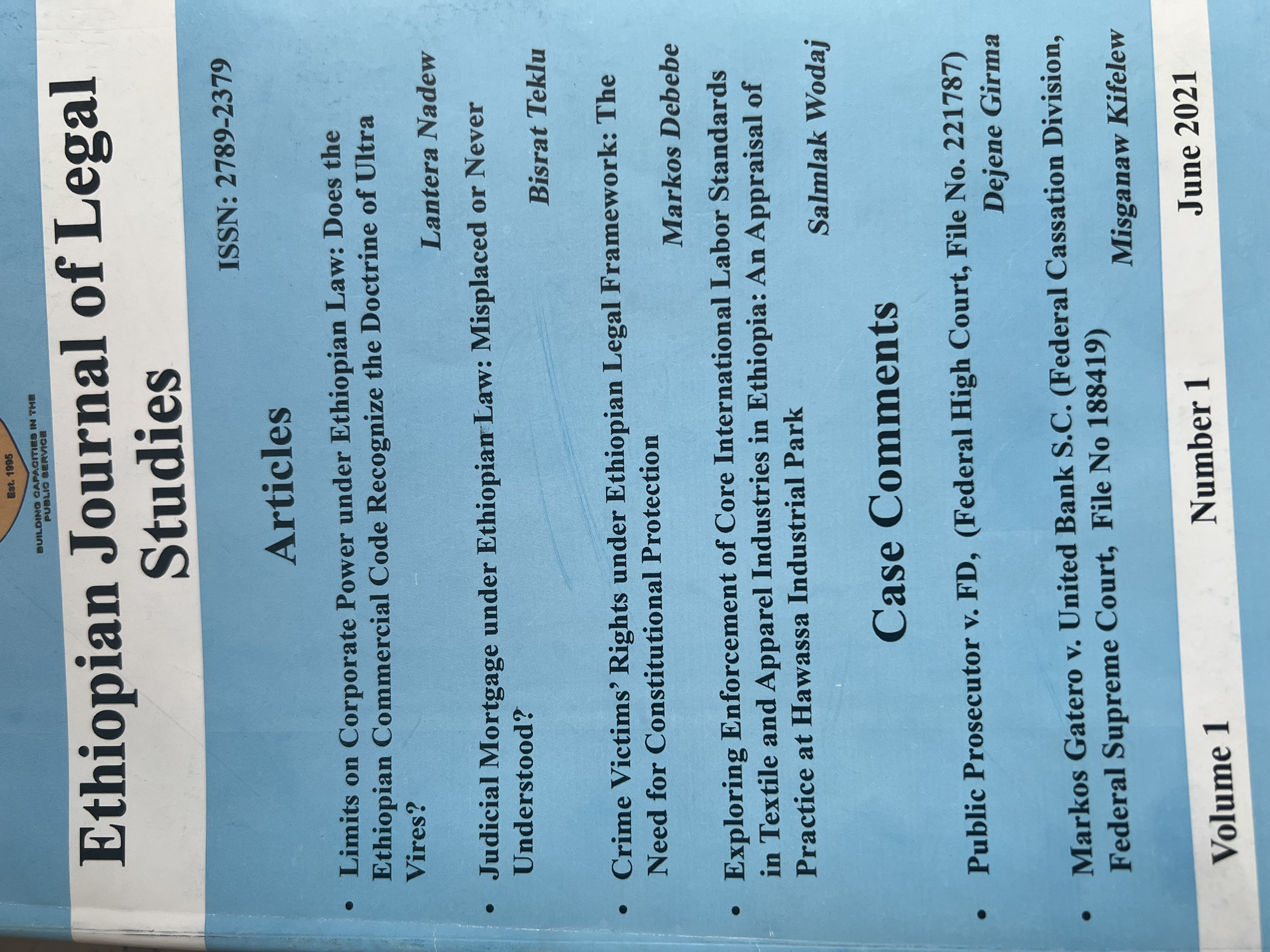
This comment criticizes the Federal Cassation Decision File No 188419 rendered on October
6, 2019 (Meskerem 25, 2012 Ethiopian Calendar) and published on Federal Court Cassation
Bench Decisions Vol. 24 from page 251 to 256. The Case in brief was that the Employer of
Ato Markos Gatro’s sister in Lebanon had transferred money to Ethiopia via Abay Bank
S.C.to the benefit of Ato Markos Gatero. But the money was paid to a wrong person who
claimed to be the real Markos Gatero by producing a Kebele Identification Card which
showed that he was Ato Markos Gatero. Although lower courts ruled that the Bank should
still pay to the real creditor, the Cassation Division reversed the lower court’s decision
arguing that the Bank had done all that is expected of it. This critic argues that a debtor who
pays to a wrong person can never escape liability by invoking its due diligence but only by
showing that it paid to a legally entitled creditor. The Cassation erred because it applied a
law unsuitable to the nature of the case (Banking Proclamation No. 592/2000 as amended by
Proclamtion No.1159/2011) i.e. banking regulation which intends to govern the relationship
between a bank and the government rather than a bank and its clients. The relationship
between a bank and its client is governed by banking transaction law in particular and
contract law in general. The relationship between Ato Markos Gatero and Abay Bank S.C. is
a contractual relationship and therefore; governed by the Contract Law.Ato Markos Gatero’s
sister, through her agent, entered into a contract of transfer of money with Abay Bank S.C.
and in this transfer contract Ato Markos Gatero was stipulated as a beneficiary. Accordingly,
the relationship between Ato Markos Gatero and Abay Bank falls under Art 1957 of the Civil
Code of Ethiopia whereby Ato Markos become a creditor and the bank becomes a debtor.
The law that governs payment to unqualified person is Article 1743 of the Civil Code.
According to this Article payment to unqualified person releases the debtor only when the
payment was on the basis of documents which are apparently legitimate (the document is not
forged but the holder is not the real creditor). In the case of Ato Markos Gatero payment is
made against forged documents and therefore; the bank bears the responsibility to make the
second payment: It is the nature of the document presented (forged vs genuine) that helps the
debtor to be released but not his diligence.
Additional Files
Published
Issue
Section
License
Copyright (c) 2021 School of Law, Ethiopian Civil Service University

This work is licensed under a Creative Commons Attribution-NonCommercial-NoDerivatives 4.0 International License.