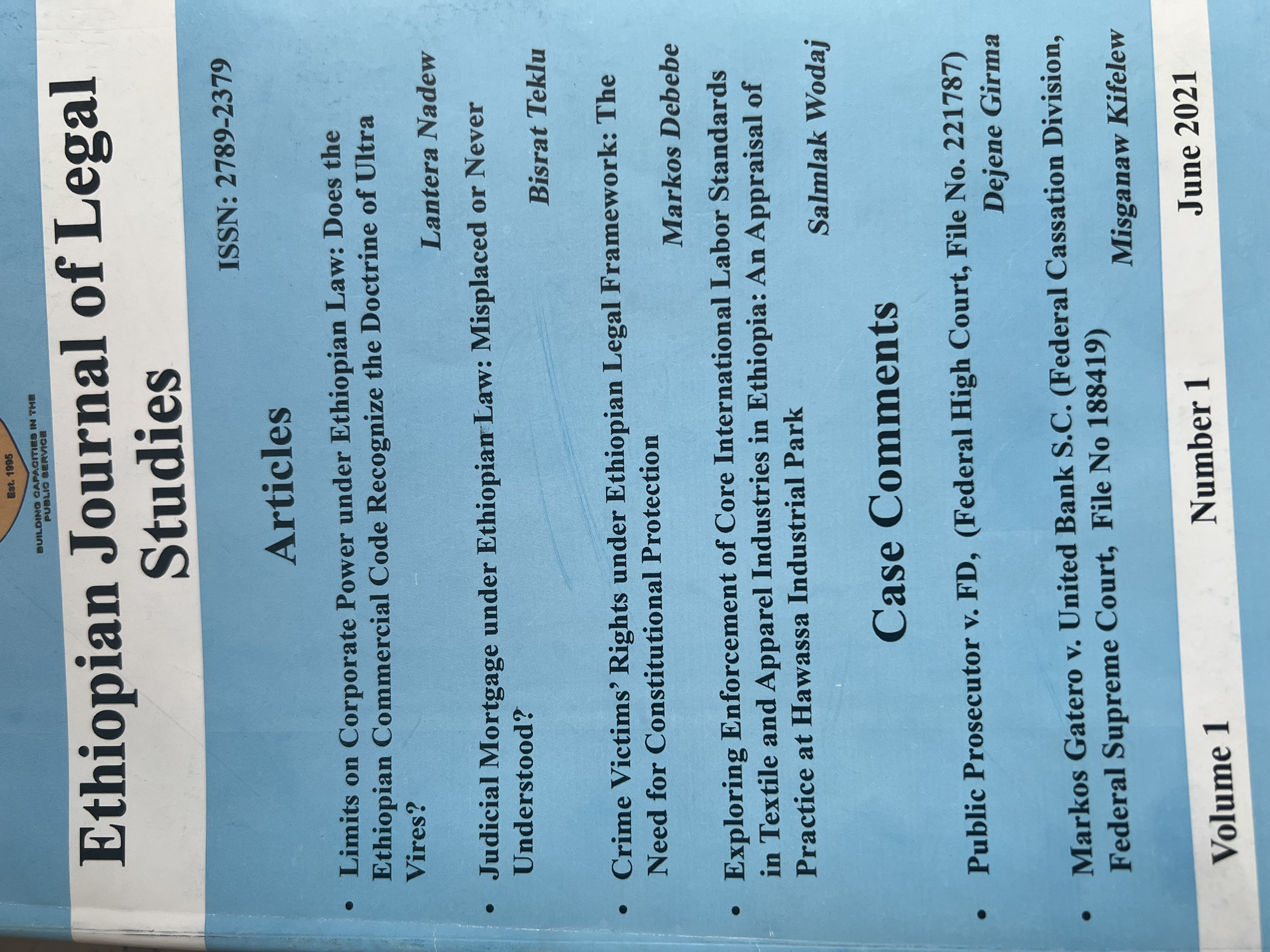
Judicial Assumption of Fact to Enable Prosecution’s Creeping Case to Stand
Abstract
Semper necessitas probandi incumbit ei qui agit is a Latin expression which essentially
means he who asserts must prove. In justice systems around the world, it has been accepted
that the burden of proof lies on someone who asserts something. Thus, in criminal cases,
prosecutions must prove every fact they allege as bases of their cases and that are denied by
the accused unless the burden of proof is expressly shifted to the accused by the law. For
instance, if A claims that B intentionally killed C, A must prove that the act of B, which in
reality was homicide, was committed intentionally. If this element is not proved, then the
prosecution (A) will not have a case unless there is an alternative charge for negligence,
which should also be proved in like manner. Now, in light of this mini introduction, the
writer wants to present a comment on one case decided by the Federal High Court, Lideta
Bench, involving issuance of a cheque. In the case, the judge had to make a factual
assumption to revive prosecution’s dying case. Had it not been for that assumption, the
accused would have been acquitted, which of course, should have happened given the
prosecution’s inability to prove the foundational fact it alleged for the existence of the alleged
crime.
Downloads
Published
Issue
Section
License
Copyright (c) 2021 School of Law, Ethiopian Civil Service University

This work is licensed under a Creative Commons Attribution-NonCommercial-NoDerivatives 4.0 International License.