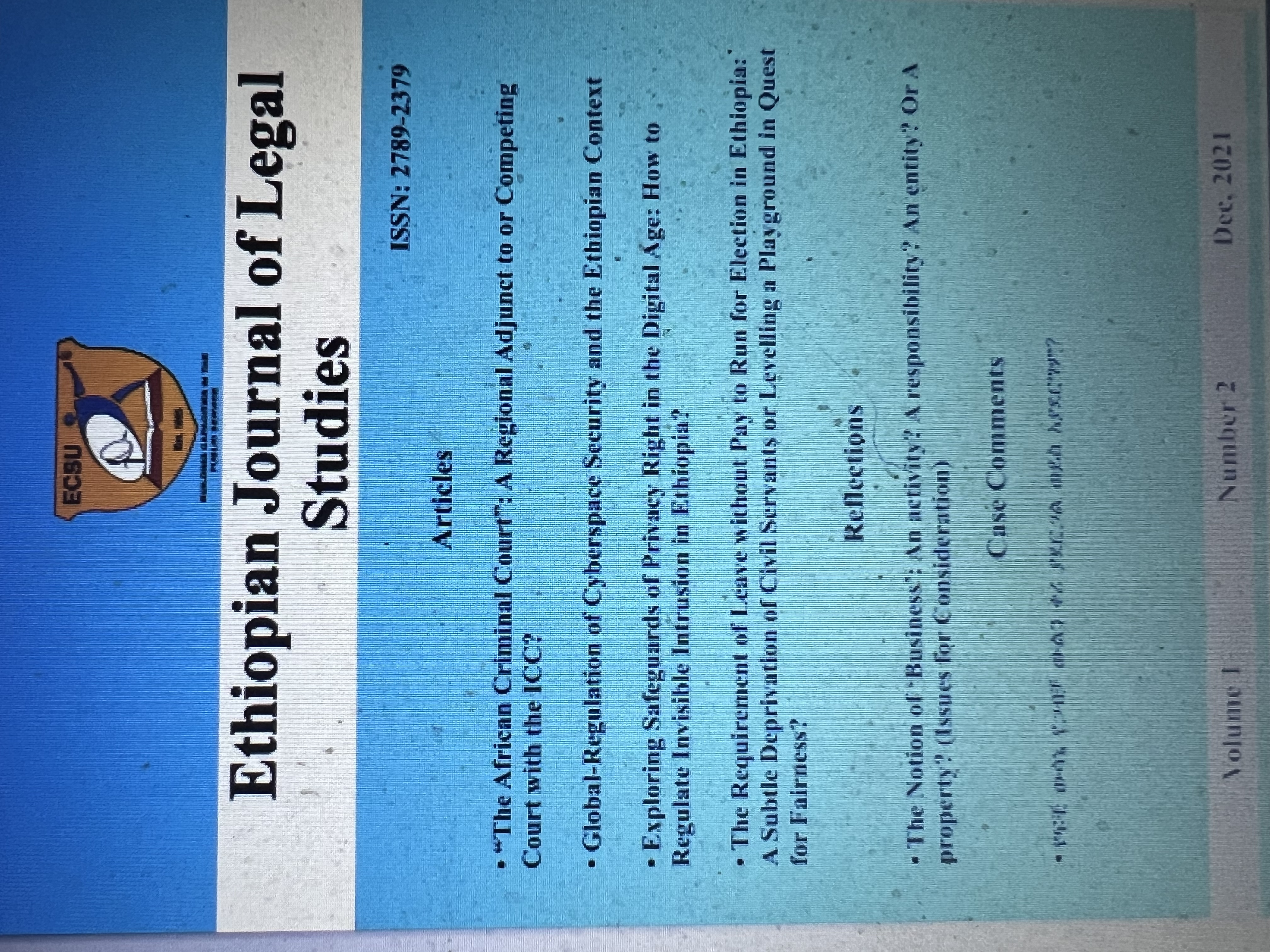
The Requirement of Leave without Pay to Run for Election in Ethiopia: A Subtle Deprivation of Civil Servants or Leveling a Playground in Quest for Fairness?
Keywords:
Civil Servants, Election norms, Election Board, Human Rights, subtle deprivationAbstract
The article assesses the critic against the new Electoral Law (Proclamation No.1162)
of 2019, which included controversial rules that require civil servants to get leave
without pay as a condition to run for elected offices. There was a hot debate against
the new rule. Opposition parts and civil servant candidates argued that the poorly
paid Ethiopian civil servants cannot withstand effects of leave without payment
during the candidacy. Ethiopian civil servants often live from pay to pay would not
choose to cost themselves their family in aspiration to serve the public. This is validly
argued as a subtle deprivation of right to be elected, which is guaranteed by the FDRE
Constitution. The deprivation is also contrary to the accepted international election
norms, international election principles and standards. This article examines the
propriety of indirect limitation on rights of Ethiopian civil servants in light of
international human rights treaties, international election rules, and experiences other
nations by primarily relying on the doctrinal research methodology.
Published
Issue
Section
License
Copyright (c) 2021 School of Law, Ethiopian Civil Service University

This work is licensed under a Creative Commons Attribution-NonCommercial-NoDerivatives 4.0 International License.