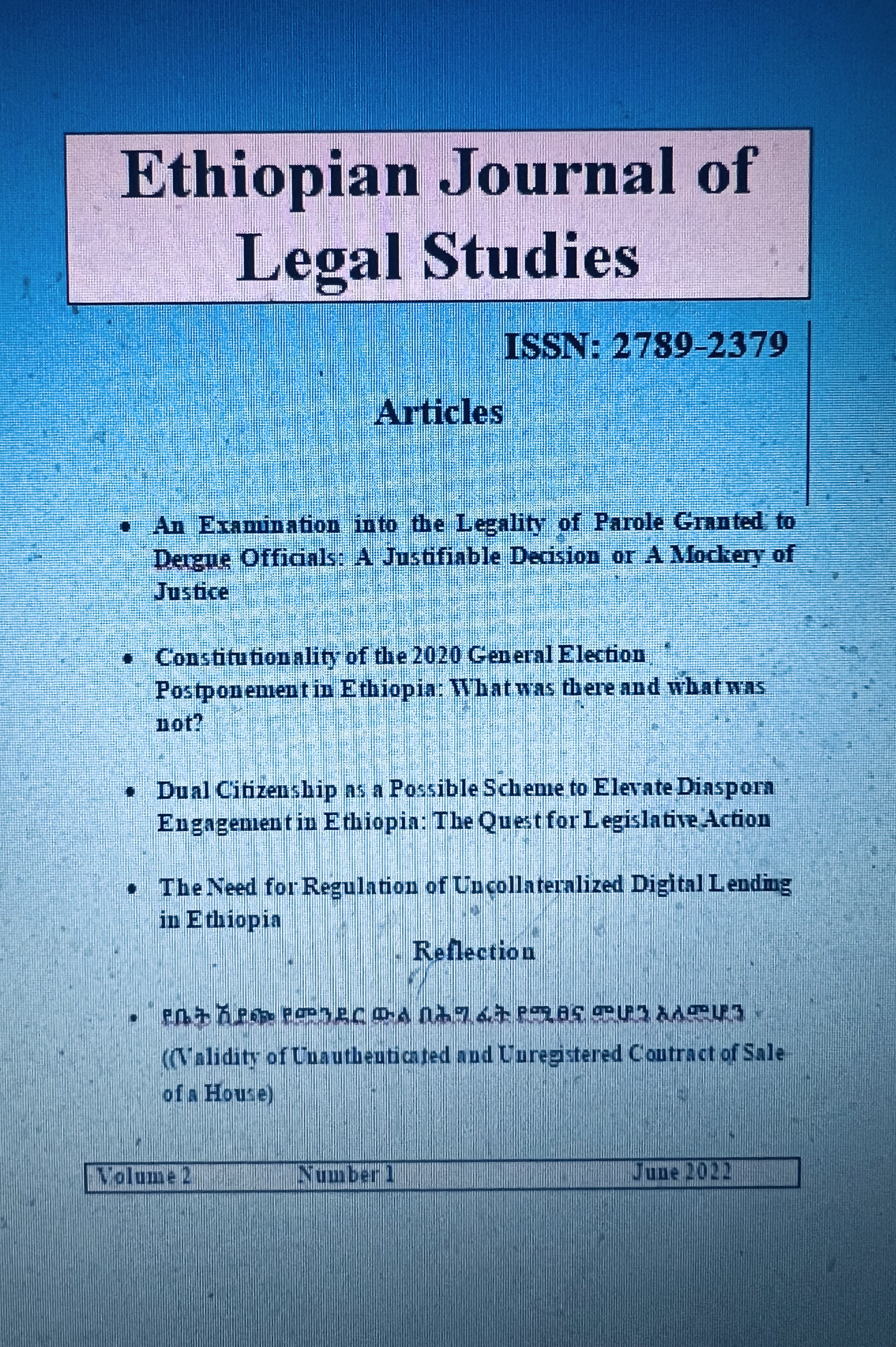
Constitutionality of the 2020 General Election Postponement in Ethiopia: What was there and what was not?
Keywords:
Review, Advisory Opinion, Concrete Review, State of Emergency, COVID 19, Election postponementAbstract
The 2020 general election of Ethiopia was postponed as the pandemic (Covid-19)
raged across the world. Due to the restrictive measures that were declared to contain
the pandemic and the infeasibility of conducting the scheduled election, the National
Electoral Board of Ethiopia proposed for postponement. To maintain the
constitutional process, multiple solutions were proposed: amendment of the
Constitution, dissolution of parliament, declaration of State of Emergency (SOE), and
constitutional interpretation. After thorough scholarly debate and deliberation,
constitutional interpretation was taken as the best remedy. The House of People’s
Representatives endorsed the chosen proposition and sent the claims to Council of
Constitutional Inquiry having sought the fate of the term of incumbency, and the
timeframe of the postponement. The House of Federation concluded that until the
possible containment of the pandemic and the State of Emergency lifted, the
scheduled election to be postponed, thereby recommending for continuity of the
incumbent government until election is conducted. Nonetheless, the whole process of
the deferment did not escape antimony. This short article examines mainly the
process of the postponement per se and the means employed, separately by applying
doctrinal research methodology, and investigates the validity of the stance taken by
the Government.
Downloads
Published
Issue
Section
License
Copyright (c) 2022 School of Law, Ethiopian Civil Service University

This work is licensed under a Creative Commons Attribution-NonCommercial-NoDerivatives 4.0 International License.